In my last article, I explored why not all value creation in private equity is equal. Why the source of returns matters as much as the size of returns. I argued that investors need to look beyond headline multiples and start risk-weighting the components of value creation, particularly when a significant share of that value remains unrealized.
That article ended with a question: if unrealized returns are only as good as the assumptions that support them, what should investors actually do about it?
In this piece, I share a practical approach to building private equity exposure with one objective in mind: generating healthy distributions to paid in capital (DPI) across the life of the private equity portfolio.
The scale of unrealized value in private equity has reached record levels. Median hold periods continue to climb. And for many investors, the recycling engine that once funded new commitments through distributions from older funds has stalled.
Howard Marks’ 2006 classic memo, “You Can’t Eat IRR,” argued that realized cash matters more than paper returns. Nearly two decades later, the message resurfaced (in a slightly different version) at last year’s Super Return Berlin conference, where giveaway hats carried an updated version of the idea: DPI > IRR. The conversation stops at the slogan. But how can we translate this awareness into a structured portfolio strategy?
At Blue Ocean Capital Advisors , we advise clients using a framework that intentionally balances capital appreciation with cash distributions in their private equity portfolios. With expected DPI being a core design principle for the portfolio from day one.
The framework operates on three levels:
- Top-down deployment across primary and secondary commitments
- Manager selection with exit discipline at its center
- Active portfolio hygiene to recycle aging positions into newer vintages

The State of Play: Why DPI Demands a Portfolio-Level Response
According to Bain & Company’s Midyear Private Equity Report 2025, recent fund-raising vintages are consistently lagging historical benchmarks for distributed to paid-in capital. For US and Western European funds raised in 2018, the DPI ratio should ordinarily be about 0.8x based on historical cash flow patterns. It currently stands just above 0.6x. For 2020 and 2021 vintages, the picture is worse.

The distribution drought is visible in the aggregate numbers. According to J.P. Morgan, distribution rates stood at just 15% of NAV in Q3 2025, versus a long-term average of 23%. Distributions as a percentage of NAV have now held below the average for three consecutive years.
Meanwhile, McKinsey’s Global Private Markets Report 2026 reveals the scale of the exit backlog: more than 16,000 PE-backed companies globally have been held for more than four years, representing 52% of total buyout-backed inventory, the highest proportion on record. The typical buyout-backed company is now held for more than six and a half years, up from an average of 6.1 years between 2011 and 2020 according to McKinsey.
“DPI is now tied with MOIC as the second most important metric shaping LP allocation decisions, with IRR remaining the leading focus. Perhaps most strikingly, DPI as a share of total PE assets under management fell to just 6% in the twelve months ended June 2025, compared with an average of 16% between 2015 and 2019. The five-year rolling DPI ratio has hit its lowest recorded level. The direction of travel is unmistakable.” McKinsey Global Private Markets Report 2026
The pressure from LPs is mounting. In a March 2025 ILPA-Bain webinar poll, more than 63% of LPs said they would prefer conventional exits, even at valuations below recent marks, over alternatives such as dividend recapitalizations or continuation vehicles. LPs are not asking for creative financial engineering. They want cash.
Level 1: Top-Down Deployment: Blending Primaries and Secondaries
The most immediate lever an investor has for improving the cash flow profile of their private equity allocation is the mix between primary and secondary fund commitments.
This is not a new idea, but it is underutilized. According to Coller Capital’s 2025 PE Barometer, 45% of LPs now consider secondaries a core pillar of their alternative investment program. Yet for many family offices and institutional investors in the GCC, secondaries are still approached with some hesitation, often viewed as a tool for when liquidity is needed rather than as a deliberate building block of the portfolio from the start.
The cash flow difference is dramatic. Cambridge Associates data shows that secondary funds typically reach a DPI of 1.0x in approximately seven years, with 40% of that capital distributed in the first five years alone. Compare that to primary PE funds, where the J-curve means investors are typically net negative on cash flow for the first four to five years, and a DPI of 1.0x may not arrive until year ten or beyond. CVC’s analysis of Preqin data across 2007–2021 vintages found that a $100 commitment to secondaries generated a peak net outlay of just $49, 39% less than the broader PE universe, and turned to positive net cash flow two years sooner.

To illustrate the impact, consider a simplified framework of what happens to the overall cash flow profile of a private equity portfolio as secondary exposure increases from 10% to 30% of total commitments:

The trade-off is real but manageable. Callan’s research found that a 100% secondary allocation outperforms in the short term but significantly underperforms over 20 years: a 1.35x TVPI versus 1.65x for an all-primary portfolio. But the relevant comparison is not the extremes. A 75/25 or 70/30 blend captures most of the cash flow benefits of secondaries while preserving the return potential of primaries.
For a family office or institutional investor with a plan to invest in private equity over a multi-year period, even a 20% allocation to secondaries can meaningfully change the liquidity profile. It accelerates the self-funding cycle, reduces the duration of capital at risk, and creates optionality to take advantage of opportunities as they arise.
Level 2: Manager Selection: Underwriting the Exit, Not Just the Entry
The second layer of a DPI-aware strategy is manager selection, and here the emphasis shifts from how a manager deploys capital to how they return it.
1️⃣ On the Primaries Side
Manager due diligence typically emphasizes sourcing, strategy, track record, and entry discipline. But a priority focus should be placed on exit strategy and expected holding periods, since these drive the timing and certainty of distributions. The analysis should also test whether current and forward market conditions can realistically support the planned exit path.
What does this mean for manager selection? It means the questions we ask need to evolve:
- Is the manager’s exit strategy consistent across vintages, or has it shifted as fund sizes have grown? A manager who exited effectively at $500 million may face very different dynamics at $2 billion. Larger funds require larger exits, which narrows the buyer universe and can extend hold periods.
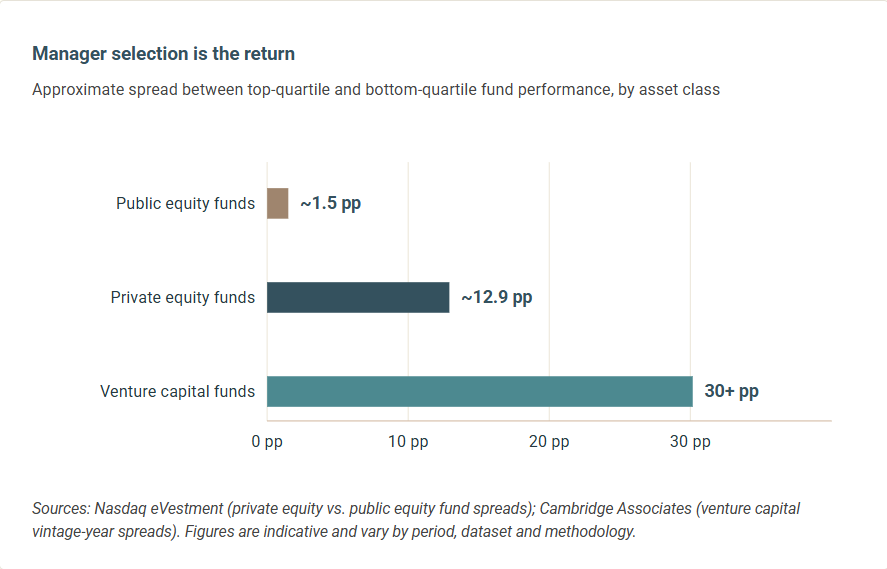
- How has the manager performed through different market cycles? A strong track record built entirely during a period of declining interest rates and expanding multiples tells you less than you might think. J.P. Morgan’s data illustrates why: the spread between top-quartile and bottom-quartile buyout IRRs for the 2021 vintage is nearly 14 percentage points, the widest since 2014. Manager selection has rarely mattered more.
- What is the TVPI-to-DPI conversion rate across prior funds? As the Chronograph analysis highlights, even well-performing GPs from the front end of the 2010s showed notable leakage between paper and realized returns when the liquidity window opened in 2020–2021. If mature funds still carry significant RVPI, ask why.
- What is the manager’s willingness to “take their medicine”? Some GPs are still holding out for the last dollar of value creation. Others have accepted that selling at a slightly lower price and returning capital to LPs is the right trade-off. Know which camp your manager falls into.
2️⃣ On the Secondaries Side
For the secondary allocation, the considerations are different but equally important.
The secondary market is no longer monolithic. LP-led transactions, where limited partners sell their stakes in existing funds, and GP-led transactions (primarily continuation vehicles) represent fundamentally different risk and return profiles.
MSCI’s 2026 trends report flags an important development: between 2016 and 2020, contributions to continuation funds averaged just 6% relative to distributions from mature PE funds. From 2021 through Q3 2025, that ratio jumped to 20%. Continuation vehicles are easing pressure, but MSCI notes that much of the existing continuation-fund universe has yet to deliver fully realized performance.
That track record, when it arrives, will be the real litmus test.
“78 of the top 100 sponsors by AUM have now completed at least one continuation vehicle transaction. GP-led secondary volume has tripled from $35 billion in 2020 to $115 billion in 2025, and 14% of all sponsor-backed exits now flow through continuation vehicles.” Jefferies
For investors constructing a secondary allocation, the blend matters:
- LP-led portfolios typically offer broader diversification, exposure across multiple GPs and vintages, and pricing at wider discounts. They provide the “beta” of the secondary market. The average age of the underlying assets will dictate how quickly distributions materialize.
- GP-led continuation vehicles tend to be more concentrated, offering exposure to specific high-conviction assets that the GP wants to hold longer. They can deliver strong returns but come with higher concentration risk and the potential for misaligned incentives between the GP and existing LPs.
- The ideal mix depends on portfolio objectives, but a thoughtful blend of both provides diversification of return drivers within the secondary allocation itself. Understanding the average remaining hold period of assets in each vehicle is critical for cash flow modeling.
Level 3: Portfolio Hygiene: Actively Managing the Tail
The third layer is active portfolio management of aging positions.
Every private equity portfolio accumulates what experienced investors politely call “tail-end exposure”: older fund positions that are past their expected lifecycle, generating little in the way of distributions, and consuming disproportionate attention relative to their remaining value.
These positions tie up capital, distort allocation percentages, and prevent the portfolio from evolving. They are the private equity equivalent of dead weight on a balance sheet.
In the current environment, the costs of inaction are rising. J.P. Morgan’s data on U.S. PE-backed inventory paints a vivid picture: 43% of portfolio companies are now in the 4–7 year holding bracket, 12% in the 8–11 year bracket, and 6% have been held for 12 years or more.

The return implications are equally telling. DealEdge data on fully realized buyout deals (first invested 2010 or later) shows that median IRRs peak in the 3 to 5 year holding window at 27%, then decline steadily as holding periods extend. By the time assets cross the seven-year mark, median returns fall to just 14%. Even top-quartile performance compresses significantly: from roughly 48% IRR for deals exited within 3 to 5 years to approximately 25% for those held beyond seven.

The data reinforces a simple but often overlooked truth: time is not a neutral variable in private equity. The longer capital sits in aging positions, the harder it becomes to generate the returns that justified the illiquidity in the first place. This is precisely why portfolio hygiene is not a back-office exercise but a return-enhancement strategy.
A proactive DPI strategy at the portfolio level includes:
- Regular portfolio triage. Systematically identify positions that are past their natural holding period and assess whether remaining value is more likely to be realized through patient holding or proactive secondary sale. Not every aging position is a problem (some have legitimate reasons for extended holds), but every aging position deserves scrutiny.
- LP-led secondary sales of tail positions. The secondary market for mature, lower-NAV fund positions has deepened considerably. While pricing for these positions may be at wider discounts, the freed capital can be recycled into newer vintages with stronger return potential. These are not distressed sales. Rather, a proactive rebalancing of portfolios.
- Cash flow forecasting. Many investors still model their PE cash flows on a static basis. A DPI-aware approach requires dynamic modeling that accounts for the expected timing of distributions from each fund, the pace of capital calls from new commitments, and the portfolio’s self-funding capacity over time.
The goal is not to maximize turnover for its own sake. The goal is to ensure that the private equity portfolio is always actively working: that capital is deployed in positions where value is being created and returned, not stranded in positions where it is being held on hope.
Today, LP interests can be sold through a well-established secondary ecosystem that includes specialized intermediaries, investment banks, dedicated secondary advisors or brokers, and even directly with other investors. The appropriate route typically depends on the size and complexity of the portfolio.
Large institutional portfolios are often executed through bank-led or advisor-managed processes to maximize pricing tension, while smaller portfolios can be placed efficiently through secondary brokers and targeted buyer networks. What was once viewed as an illiquid, last-resort option has evolved into a practical portfolio management tool that allows LPs to actively reshape exposures and manage liquidity with greater precision.
The Takeaway
Private equity has always required patience. That has not changed.
The industry’s liquidity challenge is not going to resolve itself through a single wave of exits or a sudden reopening of the IPO market. Even as conditions improve, the structural overhang of unrealized value will take years to work through. The firms that thrive will be those with disciplined approaches to converting paper value into real cash.
For investors, the implication is straightforward: DPI needs to be a core portfolio design principle, not a performance metric you review after the fact.
This means:
- Structuring primary and secondary commitments deliberately, with a clear view on how the mix affects portfolio-level cash flows.
- Selecting managers whose exit discipline matches their deployment capability, and who have demonstrated consistent TVPI-to-DPI conversion across cycles.
- Actively managing the portfolio’s tail, recycling aging positions into newer vintages rather than allowing them to atrophy.
- Building dynamic cash flow models that treat the PE portfolio as a living system, not a static allocation target
My team and I at Blue Ocean continue to develop these frameworks and integrate them into our advisory process. In a market where everyone is talking about DPI, we believe the value lies in building portfolios that are actually designed to produce it.
Because value that never reaches the surface is not value at all.
References
[1] Bain & Company. “Leaning Into the Turbulence: Private Equity Midyear Report 2025.” https://www.bain.com/insights/private-equity-midyear-report-2025/
[2] MSCI. “Private Capital in Focus: Trends to Watch for 2026.” https://www.msci.com/research-and-insights/blog-post/private-capital-in-focus-trends-to-watch-for-2026
[3] PERE / Harrison Connery. “Deep Dive: The Performance Metric That Has Become ‘Top of Mind.’” October 2025. https://www.perenews.com/deep-dive-the-performance-metric-that-has-become-top-of-mind/
[4] Chronograph. “Is DPI the New IRR for VC Fund Allocators?” November 2024. https://www.chronograph.pe/is-dpi-the-new-irr-for-vc-fund-allocators/
[5] Financier Worldwide / Foley & Lardner. “Private Equity’s New Liquidity Playbook: Creativity Now Rivals Capital.” December 2025. https://www.financierworldwide.com/private-equitys-new-liquidity-playbook-creativity-now-rivals-capital
[6] Cambridge Associates. “When Secondaries Should Come First.” https://www.cambridgeassociates.com/insight/when-secondaries-should-come-first/
[7] CVC. “Secondaries in the Spotlight: A Strategic Approach to Private Markets.” 2025. https://www.cvc.com/media/insights/2025/secondaries-in-the-spotlight/
[8] Callan. “Secondary Investments: 3 Highlights for Large Investors.” September 2025. https://www.callan.com/blog/secondary-investments/
[9] Jefferies. Global Secondary Market Review. January 2026.
[10] Coller Capital. Global Private Equity Barometer, 42nd Edition. Summer 2025.
[11] Almuzaini, Ali. “A Private Equity Deep Dive: Why Not All Value Creation Is Equal.” LinkedIn, January 2026. https://www.linkedin.com/pulse/private-equity-deep-dive-why-all-value-creation-equal-ali-almuzaini-g2rlf/
[12] McKinsey & Company. “Global Private Markets Report 2026: Clearer View, Tougher Terrain.” https://www.mckinsey.com/industries/private-capital/our-insights/global-private-markets-report
[13] J.P. Morgan Asset Management. “Guide to Alternatives.” Q4 2025. https://am.jpmorgan.com/us/en/asset-management/institutional/insights/market-insights/guide-to-alternatives/
[14] Dechert LLP. “GP-Led Secondaries and Continuation Vehicles Boost DPI and LP Liquidity Amid Fundraising Headwinds.” November 2025. https://www.dechert.com/knowledge/onpoint/2025/11/gp-led-secondaries-and-continuation-vehicles-boost-dpi.html