
In private markets, access determines what an investor can see. Diligence determines what an investor should own. A perspective on how we underwrite managers, and why the depth of the work matters more than the breadth of the pipeline.
Manager selection drives outcomes
In public markets, an allocator who does nothing more than hold the index captures the market return. Manager skill matters at the margin, but the cost of selecting an ordinary manager is modest and the position remains liquid.
Private markets operate under different economics. There is no index to hold. Each commitment is a decade-long decision to back a specific team, executing a specific strategy, at a specific point in the cycle, with limited liquidity along the way. And the difference between a strong selection decision and a weak one is not measured in basis points.
Data published by Nasdaq eVestment indicate a spread between top-quartile and bottom-quartile private equity funds of approximately 12.9 percentage points, against roughly 1.5 percentage points for public equity funds. Cambridge Associates data place the venture capital spread wider still, exceeding 30 percentage points in most vintage years. Median private equity managers have historically delivered returns broadly comparable to public equities. The asset class premium, in practice, accrues to investors positioned with managers in the upper half of the distribution.
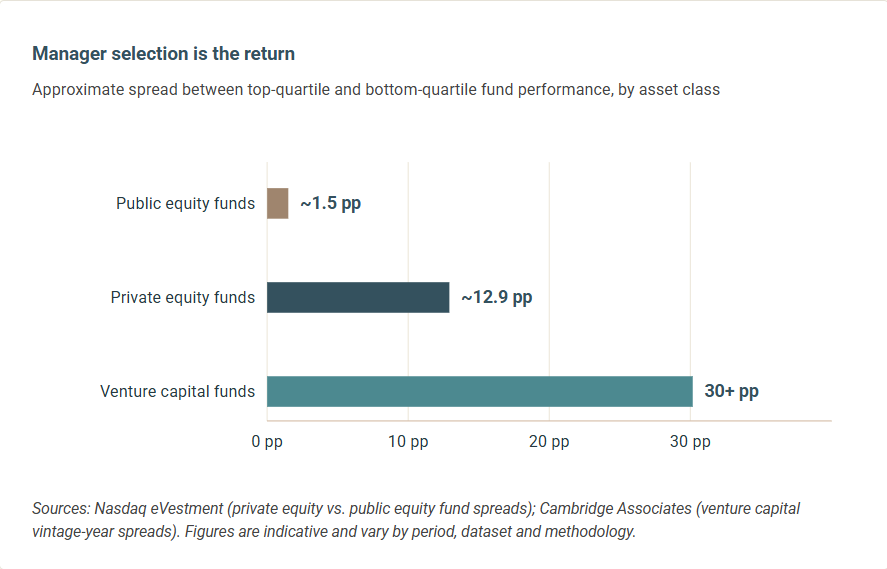
That distribution shapes our entire operating model. If dispersion is where the risk resides, then diligence, not access, is where the edge is created. What follows is how that principle is applied within our process.
Track record analysis: understanding the drivers of performance
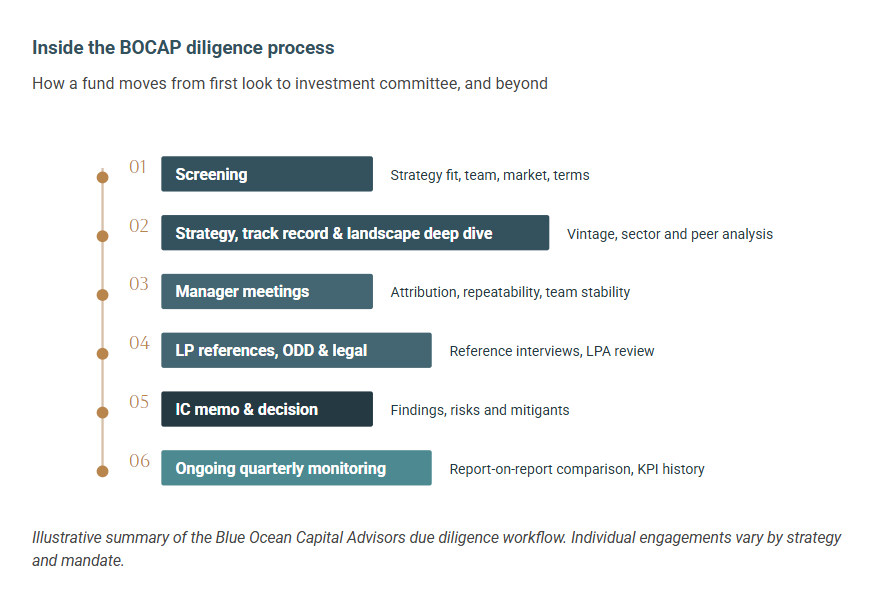
Every fund we evaluate arrives with a track record. Our work is to understand it in depth. Before any memorandum is drafted, we decompose the full performance history across every dimension that informs the investment case: by vintage, sector, geography, deal size, entry environment and realization status. We separate realized from unrealized value, examine how returns were generated, whether through earnings growth, multiple expansion or leverage, and overlay third-party benchmarks from Cambridge Associates, Preqin and PitchBook to place each fund within its true peer set and vintage context.
The purpose of this analysis is insight. Decomposing a track record reveals what worked, what did not, and why: which sectors and deal types drove outperformance, whether results were consistent across market environments or concentrated in a particular period, and how the portfolio was managed through drawdowns relative to peers.
That understanding elevates the quality of our engagement with managers. It allows us to hold substantive, forward-looking conversations about how the strategy has evolved: what the firm has taken from earlier vintages, how sourcing, underwriting and portfolio construction have been refined, and how those refinements position the current fund to build on the track record. In our experience, the strongest managers welcome this depth of dialogue. It is where conviction is built on both sides of the table.
Decomposing a track record tells you what worked and what did not. The dialogue it enables tells you how the strategy is positioned for what comes next.
Depth of analysis also matters because performance persistence is more nuanced than headline figures suggest. Research summarized by CAIS found that while roughly 70% of buyout funds following a first-quartile predecessor beat the median, funds following a bottom-quartile predecessor remained in the bottom quartile approximately 40% of the time, with several studies indicating persistence has moderated in recent vintages. A track record opens the analysis. Understanding its drivers is what completes it.
Manager meetings: assessing repeatability
By the time we meet a general partner, we have already completed our performance analysis. That preparation changes the nature of the meeting. The discussion moves quickly past the presentation and toward the substance: whether the returns were produced by the process the firm describes, and whether that process remains intact.
Our meetings concentrate on attribution and repeatability. Which investment professionals sourced and led the most significant transactions, and how the team has developed around them. How value creation has been balanced across operational improvement, growth and capital structure. How economics and succession are structured below the founding partners. How deployment pacing was managed in competitive markets, and how the firm’s investment discipline has held across cycles. A manager who can articulate not only the investments made but the opportunities declined, and the reasoning behind both, provides a far richer basis for underwriting than any performance table alone.
LP references and operational due diligence
Among the most valuable inputs in any manager evaluation is the perspective of investors who hold, or have held, positions in the manager’s prior funds. We conduct structured reference interviews with current and former limited partners, complementing the references the manager provides with independent conversations developed through our own network. Together, these perspectives address the questions that matter most over a fund’s life: how the manager communicates through difficult periods, how organizational transitions have been handled, and how reporting has aligned with outcomes.
Alongside this sits the operational and legal workstream: due diligence on fund administration, valuation policy and governance, and a detailed review of the limited partnership agreement to confirm that terms on fees, key-person provisions, recycling and GP commitment align fully with the commercial understanding. Ensuring documentation and dialogue are consistent at the outset is, in our view, one of the most effective protections an investor can secure.
Diligence does not end at commitment
Many diligence processes conclude when the subscription document is signed. Ours changes shape instead. Each quarter, every manager report across our portfolio is reviewed against the prior period: NAV progression, portfolio company performance, deployment pacing, valuation movements and developments in the manager’s commentary. Each fund’s reporting history is maintained in a structured database, allowing period-over-period changes to be identified systematically and raised with managers as part of an ongoing, constructive dialogue.
Over time, this builds something no fundraising document can offer: a longitudinal record of how each manager reports, values and communicates through the full arc of a fund’s life. That institutional memory informs every re-up decision and every new strategy we evaluate from the same firm, and it is one of the most durable assets in our process.
The edge, compounded
None of this is fast, and that is by design. In an asset class where the interquartile spread is measured in double digits, the return on diligence exceeds the return on nearly any other activity an allocator can undertake. Access is increasingly commoditized; distribution platforms will place most funds within reach. What cannot be commoditized is the discipline to analyze a track record at the level of its underlying drivers, to develop independent reference perspectives, to read fund documentation against the commercial understanding, and to sustain that analytical rigor long after capital is committed.
That work rarely appears in a marketing document. It appears where it matters: in the opportunities we decline, in the risks we identify before they are priced, and in portfolios constructed to hold their shape across a full cycle. Diligence is not a stage in our process. It is the edge itself.
Selective by design
Blue Ocean Capital Advisors is a DIFC-registered, DFSA-regulated investment advisory firm providing institutional investors, family offices and private wealth clients with access to rigorously diligenced private market opportunities across private equity, private credit and secondaries.